

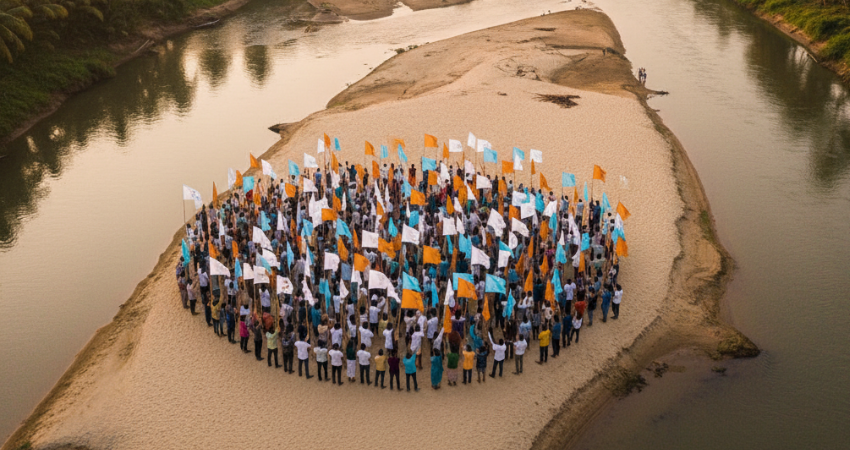
Reimagining Justice: The Fight for Legal Personhood of the Bharathapuzha River
Across the world, rivers are more than flowing water they are lifelines of culture, ecology, and community. In Kerala, the Bharathapuzha lovingly called Nila has shaped literature, livelihoods, spirituality, and landscapes for centuries. Today, however, this once-mighty river faces ecological stress so severe that large stretches run dry in summer.
In response, Friends of Bharatapuzha (FOB) has taken a historic step: approaching the Kerala High Court to seek legal personhood for the Bharathapuzha and its tributaries. The case, documented by the Eco Jurisprudence Monitor, is part of a growing global movement to recognize the Rights of Nature.
The Case: W.P. No. 15940 of 2022
Filed as Writ Petition (Civil) No. 15940 of 2022, the petition urges the Kerala High Court to declare the Bharathapuzha and its tributaries as legal persons under Indian law — with enforceable rights to:
- Exist and flow
- Maintain ecological integrity
- Regenerate and restore natural processes
- Be protected from pollution and destructive exploitation
The petition argues that conventional environmental regulations have proven inadequate to prevent:
- Excessive sand mining
- Dam-induced flow disruption
- Pollution and waste discharge
- Encroachment and floodplain degradation
Instead of treating the river merely as a “resource,” the petition asks the Court to recognize it as a rights-bearing living entity.
As noted by the Eco Jurisprudence Monitor in its coverage of the case:
“The petition seeks a paradigm shift — from regulating harm to recognizing inherent rights of the river as a living system.”
Why Legal Personhood?
Legal personhood would not make the river “human.” Rather, it would grant the river standing in court — allowing guardians or representatives to act on its behalf when its rights are violated.
The petition emphasizes that:
“The Bharathapuzha is not property. It is a living ecological system essential to present and future generations.”
This reframing transforms environmental protection from a discretionary administrative function into a rights-based obligation.
Learning from India’s Legal History
India has already seen judicial experimentation with river personhood. In 2017, the Uttarakhand High Court declared the Ganga and Yamuna as living entities with legal rights. However, that decision was later stayed by the Supreme Court of India due to questions regarding enforcement, liability, and federal authority.
The Bharathapuzha case builds on those lessons. It carefully frames its arguments within constitutional principles — including the right to life under Article 21, the public trust doctrine, and the State’s duty to protect the environment under Articles 48A and 51A(g).
Rather than symbolic recognition, the petition seeks structured guardianship and enforceable duties — aiming to avoid the legal complications that arose in earlier cases.
Why This Matters for Kerala ?
For communities across Palakkad, Malappuram, and Thrissur districts, the Bharathapuzha is:
- A source of irrigation and drinking water
- A cradle of Malayalam literary heritage
- A habitat for biodiversity
- A cultural and spiritual anchor
Its degradation has social and economic consequences — from agricultural distress to increased flood vulnerability.
Legal personhood could:
- Strengthen litigation against polluters
- Require ecological flow standards
- Mandate restoration plans
- Empower community guardianship
Most importantly, it shifts the moral and legal lens: from ownership to relationship.
A River at the Center of a Legal Transformation
The FoB petition is not merely a court case — it is part of a broader ecological awakening. Around the world, courts and legislatures are increasingly recognizing that ecosystems must be protected not just for human benefit, but for their intrinsic value.
The Bharathapuzha case asks a profound question:
Can law evolve to recognize that rivers are not objects of control, but living communities of life?
If the Kerala High Court embraces this vision, it could mark a defining moment — not only for Nila, but for the future of environmental jurisprudence in India.
The fight for Bharathapuzha is a fight for ecological dignity.
Friends of Bharatapuzha invites citizens, legal scholars, environmentalists, and community members to follow the proceedings, engage in dialogue, and support the movement toward recognizing the Rights of Nature.
Because when a river is given a voice in law, it is not only the river that is protected — it is our shared future.
